
Operating dumpers is a vital skill on construction and mining sites. But when you’re dealing with sloped terrain, the risks can increase quickly. This article explains a simple, site-friendly way to calculate slope angle in percentage form and outlines safety tips for dumper use on inclines. Whether you’re new to the industry or refreshing your knowledge, you’ll also find out how Vally Plant Training can help you become a safe, certified dumper operator in Gloucestershire. Knowing how to safely operate dumpers on slopes is crucial for every operator.
Importance of Knowing How to Safely Operate Dumpers on Slopes
Understanding how to safely operate dumpers on slopes not only enhances efficiency but also minimizes accidents on site. Professional Dumper Training in how to safely operate dumpers on slopes equips operators with essential skills to assess risks.
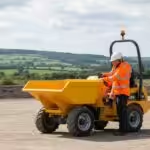
Dumpers (also called site dumpers or tipper trucks) are vehicles designed to carry and unload materials like soil, gravel, and rubble. Their tilting beds make it easy to deposit materials exactly where they’re needed. Dumpers are widely used across:
- Construction sites
- Roadworks and highway repairs
- Quarries and mines
- Landscaping projects
They range from small, walk-behind models to large articulated machines suitable for rough and uneven terrain.
Why Slope Safety Matters When Operating Dumpers
Inclines can cause dumpers to become unstable. Risks include:
- Tipping over due to uneven load or steep slope
- Sliding on wet, muddy, or gravel surfaces
- Losing control of the dumper’s speed and direction
Understanding the gradient of a slope and following proper operating techniques are essential for staying safe on site.
When learning how to safely operate dumpers on slopes, one must consider the terrain and the dumper’s capabilities. Mastering this skill significantly reduces the chances of mishaps.
How to Easily Measure a Slope On Site
Calculating the steepness of a slope doesn’t need to be difficult. Here’s a basic method using just a tape measure and a calculator (or your phone).
Step-by-Step Slope Calculation in Simple English
- Find a slope you want to measure.
- Use a tape measure to get two measurements:
- Rise – how much the slope goes up (vertical height)
- Run – how far it goes across (horizontal distance)
- Use this formula:
Slope % = (Rise ÷ Run) × 100 - Example: If the rise is 1m and the run is 5m:
(1 ÷ 5) × 100 = 20%
This means the slope is 20% – safe for many dumpers but always check your specific dumper’s limits.
Before starting any work, it’s essential to know how to safely operate dumpers on slopes to prevent accidents. Evaluating the slope and understanding how to safely operate dumpers on slopes is critical for all operators.
Simple Tools to Measure Slopes
- Slope meters/inclinometers: Show degrees or percentages directly
- Free phone apps: Download “clinometer” or “angle meter” apps
- Basic DIY method: A spirit level and tape measure can also work
Using one of these methods makes quick slope checks easy and reliable.
Best Practices for Operating Dumpers on Slopes
Before You Start
- Inspect dumper: brakes, tyres, lights, hydraulics
- Walk the route: check for debris, wet spots, loose gravel
- Evaluate weather: avoid working on slopes in rain or ice
During Operation
- Drive straight up or down – never across the slope
- Keep the load low and centered
- Go slow – sudden stops can cause tipping
- If loaded, drive uphill rather than downhill
After Operation
- Park on flat ground
- Apply handbrake and switch off
- Check tyres and components for wear or damage
Build Practical Dumper Operating Skills
Understanding a gradient calculation is useful, but it does not establish whether a particular dumper can safely use that route. The decision must account for the manufacturer’s operating limits, machine configuration, load, ground conditions and site risk assessment.
Our practical dumper training and assessment covers machine checks, stability, safe travel, loading, tipping and recognising site hazards. Beginners receive structured novice instruction, while previously trained operators can discuss refresher training. Experienced Worker Tests assess existing competence rather than teach missing skills.
Businesses can arrange training at suitable workplaces nationwide, while individuals can attend our Tewkesbury centre. Call 01684 297167 to discuss your machine and the appropriate training route.
Dumper Courses from Vally Plant Training
Vally Plant Training provides expert dumper training across Gloucestershire, offering:
- On-site training – at your workplace or construction site
- Off-site training – at our training centre
- One-to-one or group sessions
- NPORS-accredited courses
Train safely and confidently with Vally Plant Training – On-Site and Off-Site Dumper Training in Gloucestershire
Book Your Dumper Training Today
Take control of your safety and skills. Contact Vally Plant Training now to book your dumper course.
- Location: Gloucestershire, UK
- Phone: 01684 297167
- Email: info@vallyplanttraining.co.uk
- Website: www.vallyplanttraining.co.uk
Learning how to safely operate dumpers on slopes should be part of every operator’s training. This knowledge ensures that they are prepared for various conditions encountered on construction sites.
Every operator should have a clear understanding of how to safely operate dumpers on slopes to ensure their safety and that of their colleagues. Regular training updates on how to safely operate dumpers on slopes are recommended.
Conclusion
Understanding how to calculate slope angles doesn’t have to be hard. With just a few tools and a bit of simple math, you can decide whether it’s safe to operate a dumper on sloped ground. Combine that knowledge with professional dumper training from Vally Plant Training, and you’ll be fully equipped to handle real-world terrain confidently and safely.
Further Resources
Operators should always review how to safely operate dumpers on slopes before commencing work. This practice fosters a culture of safety within teams.
In conclusion, mastering how to safely operate dumpers on slopes is integral to ensuring a safe working environment. Continuous learning and training on how to safely operate dumpers on slopes will significantly reduce the risk of incidents.
Operating dumpers on slopes: your questions answered
Answers to practical questions about gradients, machine limits and dumper training. Always use the operating manual for your machine alongside the site risk assessment.
Related Posts